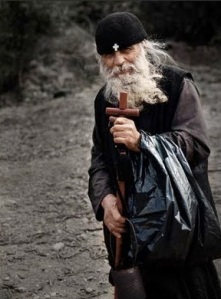
“If you want cure your soul, you need four things. The first is to forgive your enemies. The second is to confess thoroughly. The third is to blame yourself. The fourth is to resolve to sin no more. If we wish to be saved, we must always blame ourselves and not attribute our wrong acts to others. And God, Who is most compassionate, will forgive us.”

- St. Cosmas of Aitolia

“The drunkard, the fornicator, the proud – he will receive God’s mercy. But he who does not want to forgive, to excuse, to justify consciously, intentionally… …that person closes himself to eternal life before God, and even more so in the present life. He is turned away and not heard.”

- Elder Sampson of Russia

“Abba Poemen also said this about Abba Isidore that whenever he addressed the brothers in church he said only one thing, ‘Forgive your brother, so that you also may be forgiven.’”

- From the Desert Fathers

Someone sent this to me, and I thought it was worth sharing. It is the faces of a few holy men and women after their repose. I am not sure about the others, but the first of these (Elder Joseph of Vatopedi) reportedly did not start to smile until 45 minutes after his death! May God grant us all to strive to share in the same blessed experience.

St. Peter of Damascus

“Thus we should all give thanks to Him, as it is said: ‘In everything give thanks’ (I Thessalonians 5:18). Closely linked to this phrase is another of St. Paul’s injunctions: ‘Pray without ceasing’ (I Thessalonians 5:17), that is, be mindful of God at all times, in all places, and in every circumstance. For no matter what you do, you should keep in mind the Creator of all things. When you see the light, do not forget Him who gave it to you; when you see the sky, the earth, the sea and all that is in them, marvel at these things and glorify their Creator; when you put on clothing, acknowledge whose gift it is and praise Him who in His providence has given you life. In short, if everything you do becomes for you an occasion for glorifying God, you will be praying unceasingly. And in this way your soul will always rejoice, as St. Paul commends (I Thessalonians 5:16). For, as St. Dorotheos explains, remembrance of God rejoices the soul; and he adduces David as witness: ‘I remembered God, and rejoiced’ (Psalms 77:3).”

- St. Peter of Damascus

“I do not dare to ask for relief in any of my battles, even if I am weak and utterly exhausted: for I do not know what is good for me. ‘Thou knowest all things’ (John 21:17); act according to Thy knowledge. Only do not let me go astray, whatever happens; whether I want it or not, save me, though, again, only if it accords with Thy will. I, then, have nothing: before Thee I am as one that is dead; I commit my soul into Thy pure hands, in this age and in the age to be. Thou art able to do all things; Thou knowest all things; Thou desirest every kind of goodness for all men and ever longest for my salvation. This is clear from the many blessings that in Thy grace Thou hast bestowed and always bestowest on us, visible and invisible, known to us and unknown; and from that gift of Thyself to us, O Son and Logos of God, which is beyond our understanding. Yet who am I that I should dare to speak to Thee of these things, Thou searcher of hearts? I speak of them in order to make known to myself and to my enemies that I take refuge in Thee, the harbor of my salvation. For I know by Thy grace that ‘Thou art my God’ (Psalms 31:14).”

- St. Peter of Damascus

“I have miserably bowed down to the pleasures of the body becoming wholly enslaved to the demons that provoke the passions. I have become a stranger to Thee, O Lover of mankind. But now I cry with the voice of the Prodigal: I have sinned, O Christ, despise me not, for Thou alone are merciful.

I do not dare look up at the height of heaven, O King of all: I cry out: I have sinned; for in my foolishness, I alone have angered Thee, rejecting Thy commandments. Therefore, only Good One, do not cast me away from Thy presence.

At the prayers of the apostles, martyrs and prophets, the holy saints and the righteous, O Christ my Lord, forgive me all the offenses which have provoked Thee to anger in Thy goodness, and I shall sing Your praises for evermore.”

From the Canon of the Prodigal Son, Ode 7

“If people could behold in what glory a priest celebrates the Divine Office they would swoon at the sight; and if the priest could see himself, could see the celestial glory surrounding him as he officiates, he would become a great warrior and devote himself to feats of spiritual endurance, that he might not offend in any way the grace of the Holy Spirit living in him.

As I pencil these lines my spirit rejoices that our pastors are in the likeness of the Lord Jesus Christ. But we, the flock, though we have grace but in small measure – we, too, are in the likeness of the Lord. Men ignore this mystery but St. John the Divine told us clearly: “We shall be like him”, (1 John iii:2) and this not only after death but even here and now, for the merciful Lord has given the Holy Spirit on earth, and the Holy Spirit lives in our Church, lives in all virtuous pastors; lives in the heart of the faithful. The Holy Spirit teaches the soul to fight the good fight; gives the strength necessary to fulfill the commandments of the Lord; stablishes us in all truth; and has so adorned man that he has become like unto the Lord.

We must always bear in mind that a father-confessor performs the duties of his office in the Holy Spirit, wherefore we must venerate him. Know this, brethren, that if anyone should die with his confessor present, and, dying, say to him: ‘O holy father, give me the blessing that I may behold the Lord in the Kingdom of Heaven,’ and the confessor should answer, ‘Go, child, and look upon the Lord,’ it would be with him according to the confessor’s blessing, for the Holy Spirit both in heaven and on earth is one and the same.

Great power lies in the prayers of a spiritual father. For my pride I suffered much from devils but the Lord humbled me and had mercy on me because of my spiritual father’s prayers, and now the Lord has revealed to me that the Holy Spirit dwells in our father-confessors, wherefore I hold them in deep respect. Because of their prayers we receive the grace of the Holy Spirit, and joy in the Lord, Who loves us and has given us all things needful for our soul’s salvation.

If a man does not open his heart to his confessor, his will be a crooked path that leads not to salvation; whereas he who keeps nothing back will go straightway to the Kingdom of Heaven (…)

Whoever would pray without ceasing must have fortitude and be wise, and in all things consult his confessor. And if your father-confessor has not himself trodden the path of prayer, nevertheless seek counsel of him, and because of your humility the Lord will have mercy on you, and keep you from all wrong. But if you think to yourself, ‘My confessor lacks experience and is occupied with vain things, I will be my own guide with the help of books,’ your foot is set on a perilous path and you are not far from being beguiled and going astray. I know many such who reasoned thus and so deceived themselves, and they did not thrive because they despised their confessors. They forgot that the saving grace of the Holy Spirit is at work in the sacrament of confession. In such wise does the enemy delude those who fight the good fight – the enemy would have no men of prayer – while the Holy Spirit gives good counsel to the soul when we harken to the advice of our pastors.

Through the father-confessor the Holy Spirit operates in the sacrament (of confession), and this is why the soul, on leaving her confessor, feels renewed through peace and love for her neighbour. But if you are troubled when you leave your confessor, it means that you have not made a clean confession of your sins, and have not in your soul forgiven your brother his transgressions.

A confessor should rejoice when the Lord brings him a soul for repentance, and according to the grace given to him he should heal that soul, wherefore he will receive great mercy from God, as a good sheperd of his sheep.”

- St. Silouan the Athonite

This is so sublimely beautiful! The footage is from the Monastery of St. John of Shanghai and San Francisco, in Manton, CA. Thank you Handmaid Leah for drawing my attention to it.


“The man who is conscious of his sins is greater than he who profits the whole world by the sight of his countenance. The man who sighs over his soul for but one hour is greater than he who raises the dead by his prayer while dwelling amid many men. The man who is deemed worthy to see himself is greater than he who is deemed worthy to see the angels, for the latter has communion through his bodily eyes, but the former through the eyes of his soul. The man who follows Christ in secret mourning is greater than he who praises Christ amid the congregations of men.”

- St. Isaac the Syrian

“If the Holy Spirit is peace of soul, as He is said to be, and as He is in reality, and if anger is disturbance of heart, as it actually is and as it is said to be, then nothing so prevents His presence in us as anger.’

Though we know very many intolerable fruits of anger, we have only found one, its involuntary offspring, which, though illegitimate, is nevertheless useful. I have seen people flaring up madly and vomiting their long-stored malice, who by their very passion were delivered from passion, and who have obtained from their offender either penitence or an explanation of the long standing grievance. I have seen others who seemed to show a brute patience, but who were nourishing resentment within them under the cover of silence. And I considered them more pitiable than those given to raving, because they were driving away the holy white Dove with black gall. We need great care in dealing with this snake; for it too, like the snake of physical impurities, has nature collaborating with it.”

- St. John Climacus (The Ladder, Step 8.15-16)

This is the message we have heard from him and proclaim to you, that God is light, and in him is no darkness at all. If we say we have fellowship with him while we walk in darkness, we lie and do not practice the truth. But if we walk in the light, as he is in the light, we have fellowship with one another, and the blood of Jesus his Son cleanses us from all sin. If we say we have no sin, we deceive ourselves, and the truth is not in us. If we confess our sins, he is faithful and just to forgive us our sins and to cleanse us from all unrighteousness.

(1 John 1:5-9)

-

“Penitence is the gateway that leads out of darkness into light. He who does not enter into the light has not properly gone through the gate of repentance; for had he done so, he would have been in the light. He who does not repent commits sin, because he is not penitent, for ‘whoever knows what is right to do and fails to do it, for him it is sin’. He ‘who commits sin is the slave of sin’ and ‘hates the light and does not come to the light, lest his deeds should be exposed’. But now we have willingly and of our own accord entered into the light through penitence…”

- St. Symeon the New Theologian 


Next Page »

Follow

Get every new post delivered to your Inbox.

Join 64 other followers